What Is DA Domain Authority?
Introduction
When someone builds a website, one common question comes up very early:
“Why does my site not rank on Google even after publishing content?”
To understand this, SEO tools created a scoring system that helps website owners estimate how strong a website is compared to others. This score is not from Google itself, but it is widely used by SEO experts to measure progress, competition, and link strength.
This guide explains this concept in simple, beginner-friendly language, using real examples and practical explanations. No technical jargon. No confusion.
Understanding Website Strength in Simple Terms
Think of the internet like a neighborhood of houses.
- Each website is a house
- Google is like a visitor deciding which house looks trustworthy
- Some houses look strong, clean, and well-known
- Others are new or still under construction
SEO tools give each website a strength score so you can understand where your house stands in the neighborhood.
This score helps you:
- Compare your site with competitors
- Decide how hard it will be to rank
- Track SEO improvement over time
Who Created This Score and Why
This metric was introduced by Moz, a well-known SEO software company. Their goal was simple:
👉 Help website owners predict ranking potential without waiting months for Google results.
Important to know:
- Google does not use this score directly
- It is a third-party metric
- SEO professionals still rely on it heavily
Because it is consistent and widely trusted, it has become an industry standard.
How the Score Is Calculated (Easy Explanation)
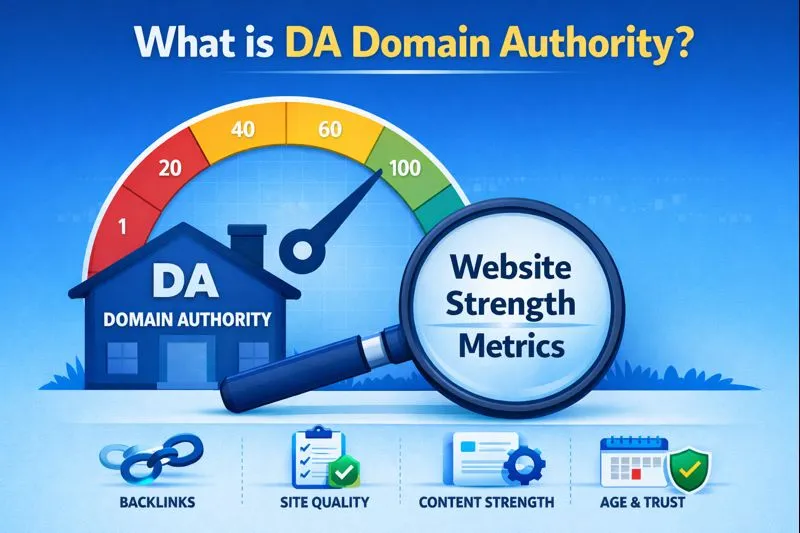
The score is calculated on a scale from 1 to 100.
Higher scores mean stronger websites.
SEO tools look at many factors, such as:
- Number of websites linking to you
- Quality of those websites
- Natural vs spammy links
- Overall link profile strength
Example:
- A new blog may start at 1–10
- A growing niche site may reach 20–40
- Big brands like news sites often have 80+
The scale is logarithmic, meaning:
- Going from 10 to 20 is easier
- Going from 70 to 80 is very difficult
Why This Score Matters for SEO
Even though Google does not officially use it, this metric is extremely useful.
It helps you:
- Understand ranking difficulty
- Choose smarter keywords
- Analyze competitors
- Measure link-building success
Imagine two houses:
- One has many respected neighbors recommending it
- The other has no one vouching for it
Which one would you trust more?
Google works in a similar way with links.
Common Myths Beginners Believe
Let’s clear some confusion.
Myth 1: Higher score guarantees ranking
❌ False
Content quality, search intent, and on-page SEO still matter more.
Myth 2: This score comes from Google
❌ False
It is calculated by SEO tools only.
Myth 3: You can increase it overnight
❌ False
Real growth takes time and clean SEO practices.
How Beginners Can Improve Their Website Strength
Here are safe and proven steps that work long-term.
-
Create Helpful Content
Write content that genuinely solves problems.
Google rewards usefulness.
Example:
Instead of writing:
“SEO tips”
Write:
“Step-by-step SEO checklist for small blogs”
-
Earn Quality Backlinks
One strong link is better than ten weak ones.
Good sources:
- Guest posts
- Niche blogs
- Business directories
- Resource pages
Avoid:
- Spam links
- Automated tools
- Paid link farms
-
Fix Technical SEO Basics
Make sure your site:
- Loads fast
- Works on mobile
- Has clean URLs
- Uses HTTPS
🔗 Helpful Guide (DoFollow):
https://developers.google.com/search/docs/fundamentals/seo-starter-guide
-
Be Patient and Consistent
This score grows slowly, just like trust in real life.
How to Check Your Website Score
You can check it using trusted SEO tools like:
- Moz
- Ahrefs
- SEMrush
- DA PA Checker
Free tools are good for beginners to track progress.
Final Thoughts
This score is not a ranking factor, but it is a powerful SEO compass.
It helps you:
- Measure authority
- Understand competition
- Plan smarter SEO strategies
Focus on:
✔ Helpful content
✔ Clean backlinks
✔ Long-term trust
If you build your website for real people, search engines will follow.