What is PA Page Authority and How it Affects Your Ranking

What Is Page Authority (PA) and How Does It Affect Your Rankings 2026 Guide?

Two pages on the same website. Same topic. Same word count. One ranks on page one of Google. The other sits on page five and gets almost no traffic.

The difference is often Page Authority.

This guide explains exactly what Page Authority is, how it is calculated, what a good score looks like, and the practical steps you can take to improve it — one page at a time.


What Is Page Authority?

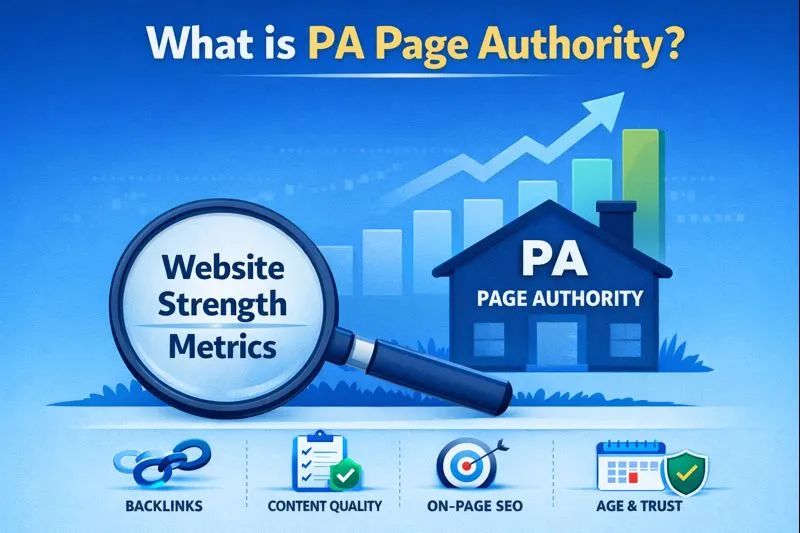
Page Authority (PA) is a score from 1 to 100 developed by Moz that predicts how well a specific page on your website will rank in search engine results.

Unlike Domain Authority — which measures the overall strength of an entire website — Page Authority focuses on a single URL. It tells you how much ranking power that one page has earned based on its backlink profile and other signals.

The higher the PA score, the stronger the page’s ability to rank for competitive search queries.

A new blog post on a brand new site might have PA 1. A well-established page on a major publication — linked to by hundreds of websites — can reach PA 60, 70, or higher.

Important to know: Page Authority is a Moz metric. Google does not use PA in its official ranking algorithm. But the factors that build high PA — quality backlinks pointing directly to a page, strong internal linking, and high-quality content — are the exact same factors Google uses to rank pages. This is why PA consistently correlates with real search rankings.


Page Authority vs Domain Authority — What Is the Difference?

This is the most common question beginners ask, and the answer is straightforward.

Page Authority (PA) Domain Authority (DA)
What it measures Strength of one specific page Strength of the entire website
Scale 1 to 100 1 to 100
Based on Backlinks to that individual URL Backlinks to the whole domain
Best used for Evaluating individual blog posts, landing pages Comparing overall website strength
Changes when Links are built to or removed from that page Links are built to or removed from any page

Think of it this way: Domain Authority is the reputation of your entire company. Page Authority is the reputation of one specific product you sell. A company can have a strong overall reputation while one product is barely known — and vice versa.

Both scores matter for SEO, but they answer different questions. If you are trying to rank a specific blog post, PA is the more relevant metric to track.


How Is Page Authority Calculated?

Moz calculates PA using a machine learning model that considers multiple link-based signals. The most important factors are:

External Backlinks to the Page

The number and quality of links from other websites pointing directly to that specific URL. A single link from a high-authority news site can push a page’s PA significantly higher than dozens of links from low-quality sources.

Internal Links Pointing to the Page

Every time another page on your website links to this URL, it passes a portion of its own Page Authority. A well-structured internal linking system distributes authority across your site — pages that receive more internal links build higher PA over time.

Quality of Linking Pages

Not just how many pages link to you, but how authoritative those linking pages themselves are. A link from a page with PA 60 is worth far more than a link from a page with PA 10.

Anchor Text of Incoming Links

The words used in hyperlinks pointing to your page send signals about what the page is about. Natural, varied anchor text that includes relevant terms helps Moz (and Google) understand page context.

Spam Signals

Pages that attract links from spammy, low-quality, or penalized sources get penalized in PA. A clean link profile is essential for a healthy PA score.

Logarithmic Scaling

Like Domain Authority, PA is scored on a logarithmic scale. Going from PA 10 to PA 20 is much easier than going from PA 50 to PA 60. Each point higher becomes progressively harder to earn.


What Is a Good Page Authority Score?

Context matters enormously here. A PA score that is “good” in one niche may be average in another.

PA Score What It Typically Means
1 – 10 Brand new page with few or no backlinks
10 – 20 Early stage — some links, limited authority
20 – 35 Developing page — competitive in low-difficulty niches
35 – 50 Solid authority — ranks well in most medium niches
50 – 65 Strong page — competitive for difficult keywords
65 – 80 Very strong — major publications, viral content
80 + Exceptional — Wikipedia entries, viral resources

The practical benchmark is always your competition. Search for the keyword you want to rank for and check the PA of the pages that currently rank in positions 1 to 5. That gives you a realistic target for your own page.

If top-ranking pages have PA 25 to 35, you can compete with focused link building. If they sit at PA 60+, you are looking at a much longer journey to reach that level.


Why Do Two Pages on the Same Site Have Different PA Scores?

This surprises many beginners. If the whole website has DA 45, why does one blog post have PA 38 while another has PA 12?

Because PA is page-specific, not site-wide.

Every page builds its own authority based on:

  • How many external websites link directly to that page
  • How many internal links from other pages on the site point to it
  • How authoritative those linking pages are

Your homepage almost always has the highest PA on your site because it gets the most backlinks and the most internal links. A blog post published last week with no backlinks yet starts at PA 1, even if your overall website authority is strong.

This is actually useful information. It shows you which pages on your site are your strongest SEO assets and which ones need more attention.


How Page Authority Affects Your Search Rankings

PA does not directly determine your Google rankings — but it is a reliable predictor of them.

Here is how the relationship works in practice:

Pages with high PA rank for harder keywords. When Google evaluates which page to show for a competitive query, backlink authority is one of the heaviest signals. Pages with strong PA have earned that authority through links — the same signal Google values.

High PA pages attract more clicks, which can further boost rankings. A page that ranks on page one gets clicked. Clicks send behavioral signals back to Google confirming the page is relevant and useful. This creates a compounding effect.

Low PA pages struggle against strong competition. If you publish a new blog post on a competitive topic with zero backlinks, it will rarely appear on page one regardless of content quality. PA is the authority gap you need to close.

Internal linking raises PA of your priority pages. Every page on your site that links to a target page passes a portion of its own authority. If you identify three or four pages on your site with strong PA and add internal links from them to your new post, you are actively building that post’s PA without needing external backlinks.


How to Check Page Authority

Checking PA is free and straightforward.

Free Authority Checker Tools: Several free SEO authority tools let you enter a URL and instantly see its Page Authority score. Look for tools that use Moz’s data directly — these give the most accurate PA readings alongside Domain Authority and Spam Score in a single check.

MozBar Browser Extension: Moz’s free Chrome extension displays PA for every URL you visit. This is useful when researching competitors — you can see the PA of any page you land on without leaving the browser.

Moz Link Explorer: Moz’s own platform gives detailed PA data along with the specific backlinks contributing to the score. The free version allows a limited number of searches per month.


How to Improve Page Authority — Practical Steps

PA improvement comes down to one core principle: get more quality links pointing to the specific page you want to rank.

Here are the most effective methods:

1. Build External Backlinks Directly to That Page

The most direct way to raise a page’s PA is to earn backlinks from other websites pointing to that specific URL — not just your homepage.

How to do it:

  • Guest post on relevant sites and link back to the specific article, not just your homepage
  • Reach out to bloggers who have written similar content and suggest your page as an additional resource
  • Create original research, statistics, or data on the page — journalists and bloggers naturally link to data sources
  • Submit the page URL (not just your domain) to relevant resource lists and directories

2. Strengthen Internal Links Pointing to the Page

Every page on your site that links to your target page passes a share of its own PA. This is one of the fastest and most underused PA-building techniques.

How to do it:

  • Identify your 5 to 10 pages with the highest PA using a free SEO tool
  • Add contextual links from those high-PA pages to the page you want to boost
  • When you publish new content, always link to older related articles — build a web of connections, not isolated pages
  • Make sure your most important pages receive links from multiple other pages on your site, not just one or two

3. Update and Expand the Content on the Page

Content quality affects PA indirectly but meaningfully. Better content earns more links over time. If a page has thin, outdated, or unhelpful content, even websites that might have linked to it will not — and existing links may be removed when readers find the page does not deliver value.

Update underperforming pages with:

  • More detailed explanations and examples
  • Original data, statistics, or case studies
  • Better visual formatting — tables, comparison sections, step-by-step structures
  • Answers to related questions the original article did not cover

4. Fix Broken Links Pointing to the Page

Sometimes pages lose PA because links that once pointed to them broke — the linking page was updated and the link was accidentally removed, or your URL changed without a proper redirect.

Run a regular broken link check using Google Search Console or a free backlink checker. When you find broken links from external sites, reach out and ask webmasters to update the link to your current URL.

5. Consolidate Weak Pages Into One Strong Page

If you have multiple similar articles that each have a few backlinks, consider combining them into one comprehensive guide. Redirect the old URLs to the new consolidated page — all the backlinks from the merged pages now flow to a single URL, significantly boosting its PA.

This technique — called content consolidation — is one of the fastest ways to build PA without doing any new outreach.

6. Avoid Thin or Duplicate Pages That Dilute Authority

If your site has many thin, low-quality pages, they compete with your good pages for internal link equity. Authority that could flow to your strongest pages gets spread across dozens of pages that serve no real purpose.

Audit your site periodically. Noindex pages with no search value, redirect duplicates, and either improve or remove thin content. Focused authority flows more powerfully than diluted authority.


Common Mistakes That Keep PA Low

Only building links to the homepage: Many beginners focus all outreach on their homepage. This builds DA but does nothing for individual blog post PA. Always build links to the specific pages you want to rank.

Ignoring internal linking: Internal links are free PA transfers. A page you link to from ten other strong pages on your site gains measurable authority — yet most site owners add one or two internal links per article and stop there.

Chasing PA on the wrong pages. Not every page on your site needs high PA. Focus on the pages you actually want to rank — your most important service pages, cornerstone articles, and commercial content. Let other pages build gradually on their own.

Measuring PA instead of traffic: PA is a prediction tool, not an end goal. A page with PA 15 that ranks number one for a low-competition keyword earns more traffic than a page with PA 40 targeting an impossible keyword. Always tie PA goals to real traffic and ranking targets.


Summary — What You Need to Know About Page Authority

  • PA is a Moz score from 1 to 100 measuring the ranking strength of a single page
  • It is based on backlinks pointing directly to that URL, internal linking, and link quality
  • Google does not use PA officially — but the factors that build PA are the same factors Google uses to rank pages
  • A “good” PA score depends on your competition — always benchmark against the pages you are trying to outrank
  • Build PA by earning external backlinks to specific pages, strengthening internal links, and improving content quality
  • Check your most important pages regularly using a free authority checker to track progress

Frequently Asked Questions (FAQ)

  1. What is Page Authority (PA) in SEO? Page Authority is a score from 1 to 100 created by Moz that measures how well a specific web page is likely to rank in search engine results. It is based primarily on the quality and quantity of backlinks pointing to that individual URL. The higher the PA, the stronger the page’s ranking potential.
  2. What is the difference between Page Authority and Domain Authority? Domain Authority measures the overall strength of an entire website. Page Authority measures the strength of a single specific page. A site can have strong Domain Authority while individual pages have low Page Authority if those pages have few backlinks. Both scores range from 1 to 100 and are created by Moz.
  3. Does Page Authority directly affect Google rankings? Not directly — Google does not use Moz’s PA score in its algorithm. However, the factors that build high PA — quality backlinks to the page, strong internal linking, and authoritative referring pages — are the same factors Google evaluates when ranking pages. High PA pages consistently rank better because they have earned what Google values.
  4. Why is my page’s PA lower than my Domain Authority? This is normal. Domain Authority reflects the strength of your entire website’s backlink profile. Page Authority reflects only the backlinks pointing to that specific URL. Your homepage typically has the highest PA because it receives the most links. Newer or less-linked pages will always have lower PA than your overall DA.
  5. How can I quickly improve a page’s Page Authority? The fastest methods are: building external backlinks directly to that page URL (not just your homepage), adding internal links from your highest-PA pages to the target page, and consolidating related thin content into one stronger page. Internal linking is the quickest win since you control it entirely without needing third-party action.
  6. What is a good Page Authority score for a blog post? It depends on the competition for your target keywords. If the pages ranking in the top 5 positions have PA 25 to 35, that is your realistic target. There is no universal “good” PA — the benchmark is always the pages you need to outrank, not an arbitrary number.
  7. How long does it take to increase Page Authority? PA can move faster than Domain Authority because it responds to links built to a specific page. Earning even 3 to 5 quality backlinks from relevant, authoritative sites can noticeably lift a page’s PA within 4 to 8 weeks of those links being indexed by Moz’s crawler.
  8. Can internal links alone improve Page Authority? Yes, meaningfully. Internal links pass a portion of the linking page’s own PA to the target page. If you have several pages on your site with PA 30 to 40 and add internal links from them to a weaker page, that page’s PA will rise over time. Internal linking is free, fast to implement, and consistently underused by most website owners.
  9. Does deleting a page affect the PA of other pages? Yes. If you delete a page that had backlinks and did not set up a redirect, those backlinks stop passing authority. More importantly, if other pages on your site linked to the deleted page, those internal links now go nowhere — wasting the link equity they carried. Always redirect deleted pages to relevant live URLs.

Similar Posts