What Is DA Domain Authority

What Is Domain Authority? Complete Beginner’s Guide (2026)

Domain Authority is one of the first SEO terms beginners encounter — and one of the most misunderstood.

This guide explains exactly what it is, how it works, what a good score looks like, and what you should actually do with it. No fluff. Just clear answers.

What Is Domain Authority?

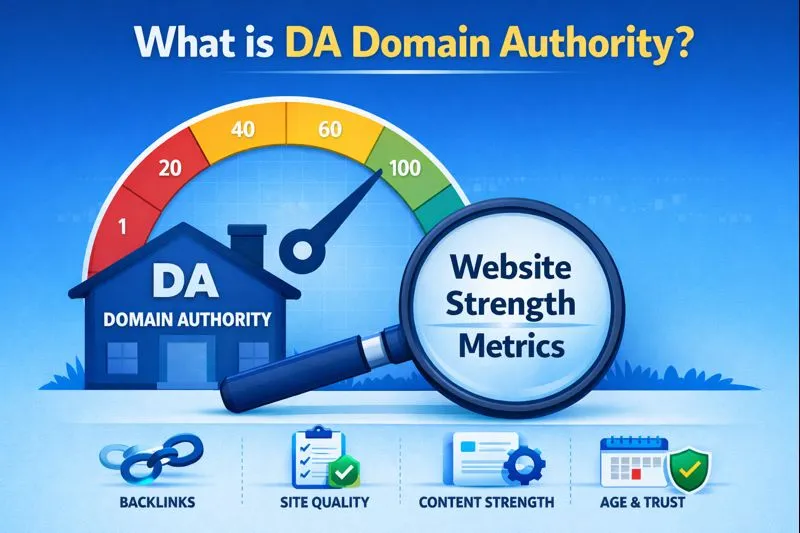
Domain Authority (DA) is a score between 1 and 100 that predicts how likely a website is to rank in Google search results. It was created by Moz, one of the most trusted SEO software companies in the world.

The higher your DA score, the stronger your website’s authority — and the better your chances of ranking for competitive keywords.

Think of it like a trust score for your website. A new blog with no backlinks starts near DA 1. Wikipedia sits at DA 93. Most competitive businesses aim to build their DA above 40 to 50 over time.

Key point: Domain Authority is a Moz metric, not a Google metric. Google does not use DA in its algorithm. But DA is based on backlink data — and backlinks absolutely do influence Google rankings. This makes DA a very useful proxy for understanding your site’s SEO strength.

Who Created Domain Authority and Why?

Moz introduced Domain Authority to give SEO professionals a simple, standardized way to measure and compare website strength.

Before DA existed, comparing websites was difficult. You could count backlinks, but raw numbers did not tell you about quality. You could look at Google PageRank, but it was rarely updated and eventually discontinued in 2016.

DA filled that gap. It gave the SEO industry a single number — updated regularly, based on real backlink data — that anyone could use to quickly evaluate a website’s authority.

Today, DA is used by:

  • SEO professionals evaluating guest post opportunities
  • Link builders deciding which sites to target for backlinks
  • Website buyers and sellers assessing site value
  • Bloggers tracking their own authority growth over time
  • Agencies reporting SEO progress to clients

You can check any website’s Domain Authority for free using Free DA PA Checker — just enter a domain and get instant results.


How Is Domain Authority Calculated?

Moz calculates Domain Authority using a machine learning model that analyzes dozens of factors — but the most important ones are:

1. Number of Referring Domains

A referring domain is a unique website that links to yours. Getting links from 100 different websites is far more powerful than getting 100 links from the same website. Diversity of referring domains is one of the strongest signals in Moz’s DA calculation.

2. Quality of Backlinks

Not all links are equal. A single backlink from a DA 80 news site is worth more than 50 links from DA 5 blogs. Moz evaluates the authority of every site linking to you and weights your score accordingly.

3. Spam Score of Your Backlink Profile

If many of the sites linking to you are spammy, low-quality, or penalized, Moz’s algorithm penalizes your DA. A clean backlink profile matters as much as a large one.

4. Link Profile Diversity and Naturalness

Natural backlink profiles include links from many different types of websites — news sites, blogs, forums, directories, social platforms. Profiles that look artificially constructed trigger negative signals.

5. Relative Scoring

DA is calculated on a logarithmic scale relative to all other websites in Moz’s index. This means:

  • Moving from DA 10 to DA 20 is relatively easy
  • Moving from DA 40 to DA 50 requires significantly more work
  • Moving from DA 70 to DA 80 is extremely difficult and takes years

What Is a Good Domain Authority Score?

There is no single “good” DA score that applies to every website. It depends entirely on your niche and who you are competing against.

DA Score What It Means
1 – 10 Very new or weak site — minimal backlink profile
10 – 20 Early stage — building foundation
20 – 35 Below average — gaining traction in less competitive niches
35 – 50 Average — competitive in most mid-level niches
50 – 65 Strong — established site with solid authority
65 – 80 Very strong — major publications and industry leaders
80 – 100 Exceptional — Wikipedia, BBC, major universities

The real question is not “is my DA good?” — it is “is my DA higher than my competitors?”

If you are targeting keywords in a niche where the top-ranking sites have DA 25 to 35, a DA 30 is perfectly competitive. If your competitors have DA 60, you need to build substantially before you can challenge them.

Always check your competitors’ DA before setting your own targets.


Domain Authority vs Page Authority — What Is the Difference?

These two metrics are closely related but measure different things:

Domain Authority (DA) Page Authority (PA)
What it measures Strength of the entire website Strength of a single page
Scale 1 to 100 1 to 100
Use case Evaluate overall site strength Evaluate individual page ranking potential
Best for Backlink prospecting, competitor analysis Checking specific landing pages or blog posts

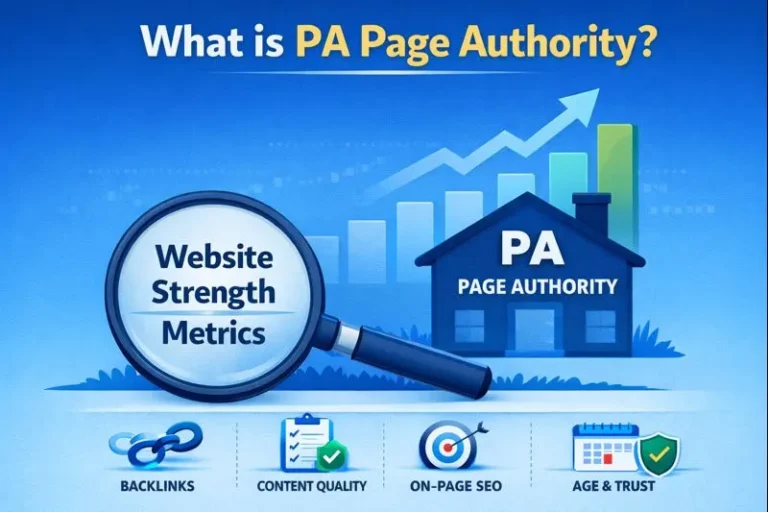
In simple terms: DA tells you how strong your house is. PA tells you how strong a specific room in that house is.


Domain Authority vs Google PageRank — Are They the Same?

No. They are completely different.

Google PageRank was Google’s original internal scoring system for websites. It was publicly visible until 2016, when Google stopped showing it. Even today, Google still uses a version of PageRank internally — it is just no longer visible to website owners.

Moz Domain Authority is a third-party metric created by Moz. It is not connected to Google’s systems in any way. Moz built it to fill the gap left when Google’s PageRank became invisible.

Both are based on backlink quality and quantity — which is why they often correlate. But they are not the same thing, and a high DA does not guarantee good Google rankings.


Does Domain Authority Affect Google Rankings?

Not directly — but indirectly, yes.

Here is how to think about it:

Google does not look at your Moz DA score when ranking your pages. But Google’s algorithm does heavily weight backlinks from high-quality, authoritative websites. Since DA measures exactly that — the quality of your backlink profile — websites with high DA tend to rank better.

It is a correlation, not a causation. High DA does not cause good rankings. But the same things that build high DA — quality backlinks, clean link profiles, strong referring domains — are also what build strong Google rankings.

So if you are working to improve your DA, you are almost certainly also improving your Google rankings at the same time.


Why Does My Domain Authority Change?

DA fluctuates — sometimes significantly — without you doing anything. Here are the main reasons:

Moz Index Updates: Moz recrawls and recalculates DA scores for all websites regularly. When a new index update rolls out, scores across all sites shift together. Your DA can drop even if your site improved — simply because the baseline changed.

You Lost Backlinks: Links disappear when websites shut down, pages get deleted, or webmasters clean up their outbound links. Fewer quality backlinks = lower DA.

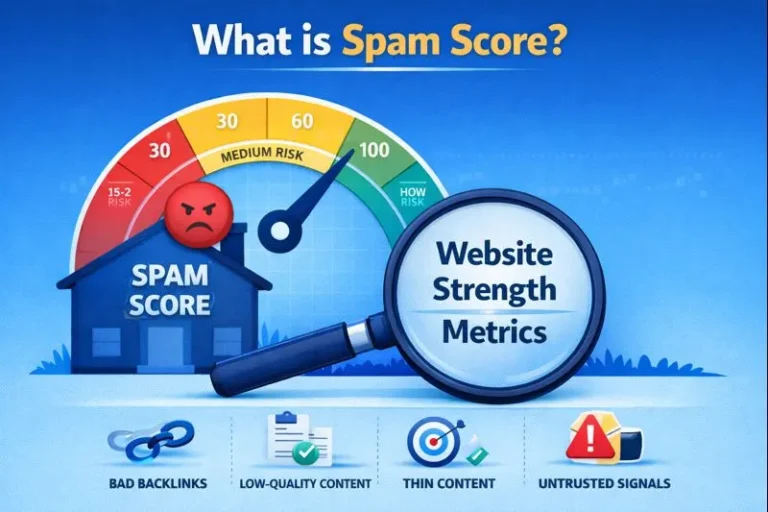
Your Spam Score Increased: New toxic links pointing to your site raise your Spam Score and pull DA down. Check your Spam Score monthly to catch this early.

Competitors Got Stronger: Because DA is relative, if competitors in your niche earned lots of strong backlinks, their DA rises — and yours can appear to fall even if nothing changed on your end.


How to Check Your Domain Authority

Checking DA is free and takes seconds. Here are your options:

1. You can use our site: dapaprochecker.com. Enter up to 5 domains at once and get DA, PA, and Spam Score instantly. No login required. Ideal for quick checks and competitor comparisons.

2. MozBar Moz’s free Chrome extension shows DA for every website you visit directly in your browser. Useful for quick on-the-go checks during research.

3. Moz Link Explorer: Moz’s full tool gives detailed backlink data alongside DA. Free with limited searches per month.


How to Improve Domain Authority

Improving DA is a long-term process — but these are the actions that move the needle most:

Build Quality Backlinks

This is the single biggest factor. Focus on earning links from websites that are relevant to your niche and have a DA higher than yours. Guest posting, digital PR, and creating linkable resources are the most reliable methods.

Remove Toxic Backlinks

Bad links drag DA down. Run a backlink audit every 3 months, identify toxic links, and disavow them through Google Search Console. Keeping your Spam Score low protects your DA.

Publish Linkable Content

Great content earns links naturally. In-depth guides, original research, free tools, and comparison articles are the content types that attract the most backlinks.

Improve Referring Domain Diversity

One link from 100 different websites beats 100 links from the same site. Actively pursue backlinks from new domains rather than getting multiple links from the same sources.

Fix Technical Issues

HTTPS, fast loading speed, mobile-friendliness, and a clean site structure all contribute to Moz’s trust signals. Technical problems raise your Spam Score and suppress DA.

For a complete step-by-step plan, read our guide on How to Increase Domain Authority from 0 to 50.


How Long Does It Take to Build Domain Authority?

Target DA Realistic Timeline
DA 0 → 20 3 to 6 months
DA 20 → 35 6 to 12 months
DA 35 → 50 12 to 24 months
DA 50 → 65 2 to 4 years

These timelines assume consistent, legitimate SEO work — quality content published regularly and backlinks earned through genuine outreach.

There are no shortcuts. Buying backlinks temporarily inflates the score but triggers spam detection and eventually causes a sharp DA drop — sometimes worse than where you started.


Common Mistakes People Make With Domain Authority

Treating DA as a Google Ranking Factor: It is not. Google does not use DA. Building DA is valuable because the same activities that raise DA also improve Google rankings — but the score itself is not what Google measures.

Comparing DA Across Niches: A DA 35 finance blog is not the same as a DA 35 craft blog. The finance niche is far more competitive. Always compare DA within your niche, never universally.

Obsessing Over the Number Instead of the Work: Some website owners check DA daily and panic at every fluctuation. DA is a trend metric — check it monthly, look at the 3 to 6 month direction, and focus on doing the work that builds it.

Buying Cheap Backlinks to Inflate DA Quickly. This is the most dangerous mistake. Low-quality purchased links raise your Spam Score, trigger manual penalties, and can result in a DA crash that takes months to recover from.


Summary — Key Facts About Domain Authority

  • Domain Authority is a Moz metric scored from 1 to 100
  • It measures the strength of a website’s backlink profile
  • Google does not use DA as a ranking factor — but the two correlate
  • DA is relative — always compare it to competitors in your niche
  • The main factors: referring domain count, backlink quality, Spam Score
  • Build DA by earning quality backlinks, publishing strong content, and keeping your Spam Score low

Frequently Asked Questions (FAQ)

What is Domain Authority in SEO? Domain Authority (DA) is a score from 1 to 100 developed by Moz that predicts how well a website is likely to rank in search engine results. It is based primarily on the quality and quantity of backlinks pointing to the domain. Higher DA means stronger authority and better ranking potential in competitive niches.

Is Domain Authority a Google ranking factor? No. Google does not use Moz’s Domain Authority score in its ranking algorithm. Google has its own internal systems for evaluating website quality. However, DA correlates strongly with Google rankings because both are influenced by the same underlying factor — quality backlinks from authoritative websites.

What is a good Domain Authority score? A good DA score depends on your niche. If your competitors average DA 30, then DA 35 is strong. If they average DA 60, you need to build much further. As a general reference: DA 40 to 50 is competitive in most mid-level niches, DA 50 to 65 is strong, and DA 65+ is reserved for major publications and established brands.

How is Domain Authority different from Page Authority? Domain Authority measures the strength of your entire website. Page Authority (PA) measures the strength of a specific page on your site. DA is used to evaluate a site overall; PA is used to evaluate individual pages or blog posts. Both are scored from 1 to 100 and created by Moz.

Can Domain Authority decrease? Yes. DA can drop when you lose backlinks, when your Spam Score increases due to toxic links, when Moz updates its index and recalibrates scores, or when your competitors grow faster than you. Regular backlink audits and consistent link building help keep DA stable and growing.

How long does it take to increase Domain Authority? Reaching DA 20 typically takes 3 to 6 months of consistent work. Getting to DA 35 to 50 takes 12 to 24 months. The higher you go, the slower progress becomes because you are competing with more established sites. Focus on monthly progress rather than day-to-day changes.

Does social media activity affect Domain Authority? Not directly. Moz does not count social shares or likes as backlinks. However, social media increases your content’s visibility, which leads more people to discover and link to it naturally. The effect on DA is indirect but real over time.

Why does my Domain Authority fluctuate without me doing anything? DA is a relative score recalculated across all websites when Moz updates its index. If competitors earned strong backlinks or if the overall baseline shifted, your score changes even with no action on your part. These fluctuations are normal — track DA monthly and focus on the 3 to 6 month trend rather than individual updates.

Is a DA 1 website worth getting a backlink from? A backlink from a DA 1 site has very little value for your own DA. However, if the site is in your exact niche, has real content, and gets some organic traffic, the link is not harmful — it just contributes minimally to your authority. Focus your outreach energy on sites with DA 20 or higher for meaningful impact.

Similar Posts