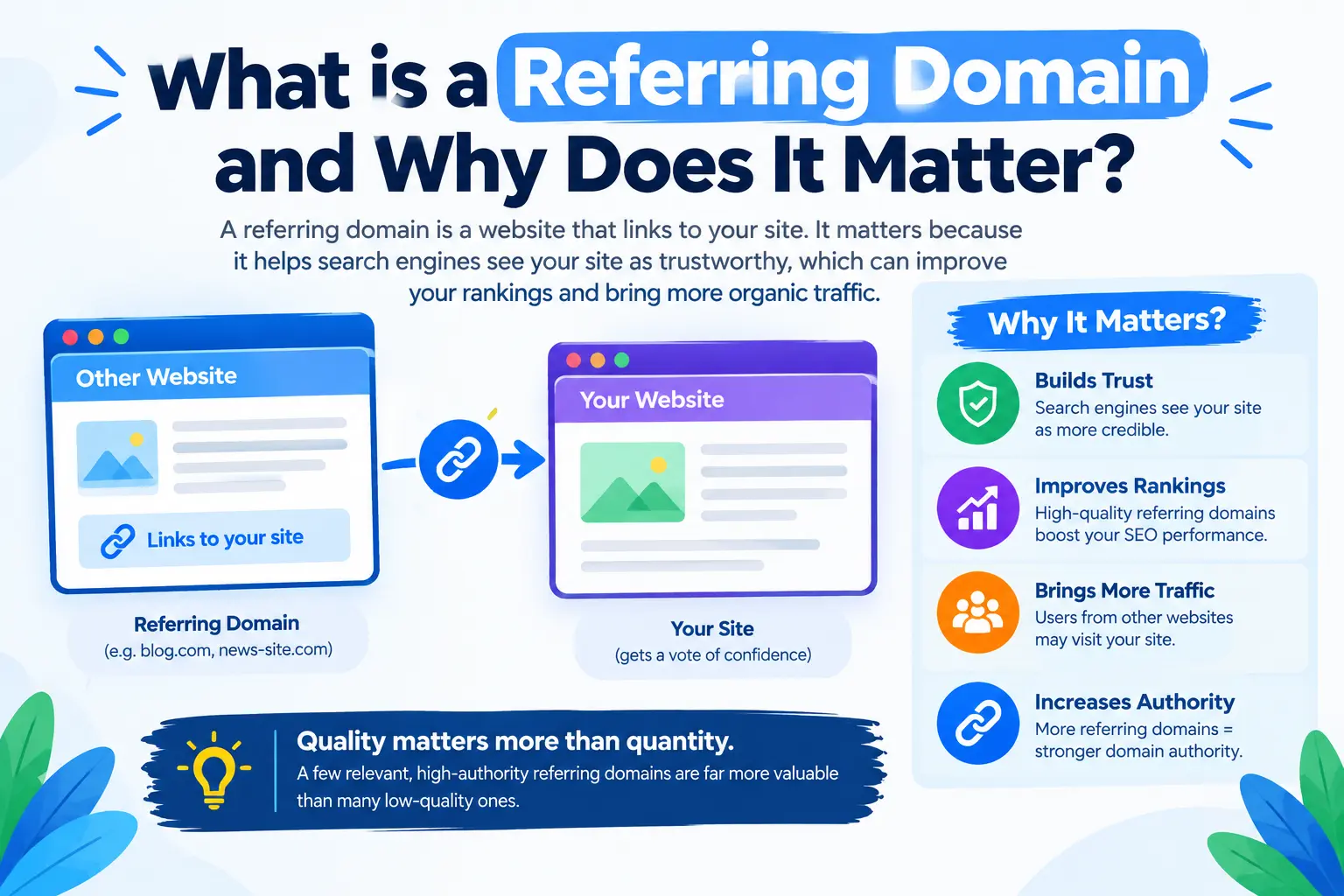
What is a Referring Domain and Why Does It Matter?
Most beginners track backlinks — but the number that actually moves your Domain Authority is the number of referring domains.
This guide explains exactly what a referring domain is, how it differs from a backlink, and why it is the metric you should be watching most closely.
What Is a Referring Domain?
A referring domain is any unique website that links to your site at least once. It is the domain — not the individual link — that counts.
If a single website links to you from 10 different pages, that is:
- 10 backlinks (10 individual links)
- 1 referring domain (1 unique website)
If 10 different websites each link to you once, that is:
- 10 backlinks
- 10 referring domains
The second scenario is far more valuable for your Domain Authority — even though the raw backlink count is identical.
Simple analogy: Imagine you are applying for a job. Would you rather have one colleague write you 10 recommendation letters, or have 10 different respected people each write one? Ten independent voices carry far more weight. Referring domains work the same way — Google values independent, diverse endorsements over repeated links from the same source.
Referring Domain vs Backlink — What Is the Difference?
This is the most common point of confusion for beginners. Here is the clearest way to understand it:
| Term | Definition | Example |
|---|---|---|
| Backlink | A single hyperlink from any page on any site pointing to your site | Forbes.com/article-1 links to you |
| Referring Domain | The unique root domain from which one or more backlinks originate | forbes.com (the domain itself) |
The key rule: One domain = one referring domain, regardless of how many pages on that domain link to you.
This matters because Moz’s Domain Authority algorithm gives diminishing returns from multiple links from the same domain. The first link from a domain passes significant equity. Each additional link from the same domain passes progressively less.
Why Referring Domains Matter More Than Backlink Count
When you see someone brag about having “5,000 backlinks,” the question that actually matters is: how many referring domains do those 5,000 links come from?
5,000 backlinks from 50 domains is a weak profile — most of that link volume is redundant. 500 backlinks from 400 referring domains is a genuinely strong profile — 400 independent sites have all chosen to link to you.
Why referring domain diversity is so powerful:
1. It signals organic, natural growth. When hundreds of independent websites link to you, it signals to Google that real people across the internet find your content valuable. This is the pattern Google trusts. A backlink profile dominated by one or two domains looks artificial — even if those domains are high-authority.
2. Each new referring domain brings fresh link equity. The first link from any domain delivers the most equity. By acquiring links from many unique domains rather than multiple links from the same domains, you maximize the total equity flowing into your site.
3. Referring domains are the primary driver of Domain Authority. Moz’s DA calculation weighs referring domain count heavily. Look at any two sites in the same niche — the one with more unique referring domains almost always has higher DA, even if the total backlink count is similar.
4. It protects against domain-level penalties. If one referring domain gets penalized or deindexed by Google, you lose only that one source of link equity. A diverse referring domain profile means no single domain has outsized influence over your authority.
How Domain Authority Responds to Referring Domains
Here is a realistic picture of how DA moves as referring domains grow:
| Referring Domains | Typical DA Range | Notes |
|---|---|---|
| 0 – 5 | DA 1 – 10 | New site, minimal authority |
| 5 – 20 | DA 10 – 20 | Early growth phase |
| 20 – 50 | DA 20 – 30 | Building momentum |
| 50 – 100 | DA 30 – 40 | Solid authority in most niches |
| 100 – 250 | DA 40 – 55 | Established competitive site |
| 250 – 500 | DA 55 – 65 | Strong niche authority |
| 500+ | DA 65+ | Major publication-level authority |
These ranges are approximate — DA also depends on the quality of referring domains, not just the count. Ten referring domains from DA 70+ sites will push DA higher than fifty referring domains from DA 15 sites.
What Makes a Referring Domain Valuable?
Not all referring domains contribute equally. These factors determine how much a referring domain moves your DA:
Domain Authority of the referring site: A link from a DA 80 referring domain contributes far more equity than a link from a DA 15 blog. The higher the authority of the site linking to you, the stronger the signal.
Topical relevance: A referring domain in your exact niche carries stronger topical relevance signals than a high-DA domain in an unrelated field. Google increasingly weights the relevance of the linking domain alongside its authority.
Spam Score of the referring domain: Referring domains with Spam Score above 50% contribute negative signals rather than positive ones. A high Spam Score on referring domains raises your own site’s Spam Score — which can suppress DA growth even as your backlink count increases.
TrustFlow of the referring domain (Majestic metric): Referring domains with high TrustFlow are close to Majestic’s trusted seed sites — major universities, established news organizations, government domains. A link from a high-TF referring domain passes genuine trust, not just raw link volume.
Whether it is a new or repeat referring domain, each new unique domain added to your referring domain count provides fresh equity. A domain that already links to you adding a second or third link provides diminishing additional value.
How to Check Your Referring Domains
Monitoring your referring domain count over time is one of the most useful SEO tracking habits you can build. Here are the free tools available:
Google Search Console (free — most important): Go to Search Console → Links → External Links → Top Linking Sites. This shows every unique domain Google has detected linking to you. Download the full list monthly to track growth.
Moz Link Explorer (free searches): Enter your domain at moz.com/link-explorer. The overview shows total referring domains alongside Domain Authority and Spam Score. Free accounts get a limited number of searches per month.
Ahrefs free preview: Enter your domain at ahrefs.com for a partial view of referring domain count and the top linking domains by Domain Rating.
Ubersuggest provides referring domain counts with their domain scores. 3 free searches per day without an account.
What to look for in your referring domain report:
- Total unique referring domain count and month-over-month growth
- Average DA/DR of referring domains — rising average quality = stronger authority growth
- Spam Score distribution — flag and investigate referring domains above 30%
- New vs lost referring domains — losing domains you earned previously is worth investigating
Referring Domains in Competitor Analysis
Referring domain data is one of the most useful inputs for understanding how to beat a competitor in search results.
Step 1 — Check competitor referring domain count. Run your top 3 competitors through a free authority checker or Moz Link Explorer. Note their referring domain counts. This tells you roughly how many unique linking domains you need to match their authority.
Step 2 — Identify referring domains linking to competitors but not you: This gap — domains that link to your competitors but not to you — is your primary link-building opportunity list. These sites have already demonstrated willingness to link to content in your niche.
Step 3 — Prioritize by quality: Sort competitor referring domains by DA. Focus outreach on the highest-authority domains first — a link from one DA 60 referring domain does more than ten DA 20 referring domains.
Step 4 — Find patterns in how they earned those links: If many of a competitor’s referring domains are news sites, they likely earned coverage through Digital PR or original data. If most are blogs, guest posting may have been their primary method. This tells you which tactics to prioritize.
Referring Domains vs Linking Pages — One More Distinction
When using SEO tools, you will often see three separate numbers:
- Referring domains — unique websites linking to you
- Referring pages (or linking pages) — unique individual pages linking to you
- Total backlinks — total number of links, including multiple from the same page
A site with DA 80 that links to you from 5 different articles shows:
- 1 referring domain
- 5 referring pages
- 5 backlinks (or more if any pages link multiple times)
For Domain Authority calculations, Moz primarily weighs referring domains. For individual page-level equity, Moz weighs referring pages. Both matter — but referring domains is the headline metric for overall site authority growth.
How to Grow Your Referring Domain Count
The goal is not just more backlinks — it is more unique websites linking to you. Every link building strategy should be evaluated through this lens.
Methods that grow referring domains most efficiently:
Guest posting on new sites — each accepted guest post from a new domain adds one referring domain. Focus on sites that have not already linked to you.
HARO journalist responses — each successful response earns a link from a unique news publication. Publications rarely link to you more than once, making HARO inherently diverse in referring domain acquisition.
Resource page outreach — each site that adds your content to their resource list is a new referring domain.
Digital PR campaigns — a single well-executed campaign can earn links from 20 to 100 new referring domains simultaneously — the most efficient method for growing referring domain count quickly.
Broken link building — each site whose broken link you replace with your content becomes a new referring domain.
What to avoid: Buying multiple links from the same domain, or guest posting repeatedly on the same 5 sites. These add backlinks but not referring domains — the less valuable metric for DA growth.
Frequently Asked Questions (FAQ)
What is a referring domain in SEO?
A referring domain is any unique website that links to your site at least once. If one website links to you from 10 different pages, it counts as 1 referring domain with 10 backlinks. Referring domains measure the diversity of your backlink profile — how many independent websites have chosen to link to you.
What is the difference between a backlink and a referring domain?
A backlink is a single hyperlink pointing from another page to your site. A referring domain is the unique website from which that backlink originates. One referring domain can produce multiple backlinks if different pages on that site all link to you. Referring domains measure breadth; backlinks measure total volume.
Why do referring domains matter more than total backlinks?
Moz’s Domain Authority algorithm gives diminishing returns from multiple links from the same domain. Each new unique referring domain delivers fresh link equity — repeat links from the same domain contribute progressively less. 100 backlinks from 100 different referring domains is significantly more valuable than 100 backlinks from 5 domains.
How many referring domains do I need to rank?
It depends on your competition. Check the referring domain counts of pages currently ranking for your target keyword. That range is your practical target. Low-competition niches may require 10 to 30 referring domains. Competitive niches often require 100 to 300+ unique referring domains from authoritative sites.
Does a referring domain with low DA still help?
Yes — but less than a high-DA referring domain. Every unique referring domain contributes some link equity, and diversity itself is a positive signal. The key is that referring domains with Spam Score above 50% can contribute negative signals. Low-DA but legitimate sites are fine. Spammy domains at any DA level are a problem.
How do I find out how many referring domains I have?
Use Google Search Console (free — most accurate for domains Google sees), Moz Link Explorer (10 free searches/month), or Ubersuggest (3 free daily searches). Each tool shows your total referring domain count, the individual domains linking to you, and their authority scores.
Can I have too many referring domains from low-quality sites?
Yes. A large number of referring domains from spammy or low-DA sites raises your Spam Score and can suppress Domain Authority growth. Quality matters as much as quantity. A profile with 500 referring domains all from DA 5 to 10 spam sites is weaker than a profile with 50 referring domains from DA 30 to 60 legitimate sites.
What is a lost referring domain and should I be concerned?
A lost referring domain is a site that previously linked to you but whose link has been removed or the page has been deleted. Some loss is normal — pages get updated, sites close. If you lose many referring domains suddenly, it may indicate a site-wide change on a major referring domain, or that a competitor has been successful with negative SEO. Monitor your referring domain count monthly to catch sudden losses early.
How do referring domains affect Domain Authority?
Referring domains are one of the primary inputs into Moz’s DA calculation. More unique referring domains from authoritative, low-spam sources consistently correlate with higher DA scores. DA growth is closely tied to referring domain growth — sites that add 10 to 20 new quality referring domains per month see steady, predictable DA improvement over 6 to 12 months.


