Guest Posting Complete Guide 2026: How to Get Backlinks That Actually Move Your DA
Guest posting is still the most reliable way to earn high-DA backlinks consistently — if you do it the right way.
This guide covers everything: finding opportunities, writing pitches that get accepted, crafting articles that editors approve, and avoiding the mistakes that get sites penalized.
What Is Guest Posting?
Guest posting (also called guest blogging) is the practice of writing an article for another website in your niche, in exchange for an editorial backlink to your own site. You provide valuable content to their audience — they give you a link that passes PageRank and builds your Domain Authority.
At its core, it is a fair exchange: the host site gets free, expert content their readers benefit from. You get exposure to a new audience and a high-quality backlink from a relevant, authoritative domain.
When done correctly, guest posting produces:
- Dofollow editorial backlinks from DA 30 to 80+ sites
- Referral traffic from engaged, niche-relevant audiences
- Brand authority — your name appears on credible industry sites
- Topical relevance signals — links from sites in your exact niche
Is Guest Posting Still Safe in 2026?
Yes — with an important distinction.
Google has not penalized guest posting itself. What Google penalizes is mass, low-quality guest posting done purely for links — thin articles, irrelevant sites, exact-match anchor text, and link farms disguised as blogs.
In 2014, Google’s Matt Cutts famously wrote “stick a fork in it: guest blogging is done” — but that post was specifically about spammy, low-quality guest posting. Google’s own John Mueller has since clarified that quality guest posting on legitimate sites remains an acceptable and common practice.
The test Google applies: Would this article exist if there was no link involved? If the content genuinely adds value to the host site’s readers, the link is legitimate. If the article exists purely as a vehicle for a link, it is the kind of guest posting Google targets.
Safe guest posting in 2026:
- Articles written to genuinely help the host site’s audience
- Published on topically relevant sites with real readership
- Links placed naturally within the context of the content
- Varied anchor text — not always exact-match keywords
- 1 to 2 links per article maximum
Step 1 — Find Guest Post Opportunities
The most time-consuming part of guest posting is finding the right sites. Here are the most effective methods:
Google Search Operators
These search queries reveal sites that actively accept guest contributors:
your niche + "write for us"
your niche + "guest post guidelines"
your niche + "submit a post"
your niche + "contribute"
your niche + "guest author"
your niche + "become a contributor"
your niche + "accepting guest posts"
Examples for the SEO niche:
SEO "write for us"digital marketing "guest post guidelines"link building "submit a post"
Run each query and note every site that appears. You will quickly build a list of 20 to 50 potential targets.
Competitor Backlink Analysis
Check where your competitors have published guest posts. Their guest post backlinks are sites already proven to accept content in your niche.
Use Moz Link Explorer or any free authority checker — enter a competitor’s domain and look through their referring domains. Look for links with anchor text matching their author name or brand alongside a content URL (e.g., /blog/article-title). These are almost certainly guest post links.
Social Media Research
Search Twitter/X and LinkedIn for "guest post" + your niche or "I wrote for" + major sites in your niche. Many guest posters announce their published pieces — which reveals the sites accepting contributions.
Reverse engineering established writers
Find 3 to 5 prolific writers in your niche who publish across many sites. Search their name on Google: "Author Name" guest post. Every site that has published their work is a potential target for your own pitch.
Step 2 — Evaluate Sites Before You Pitch
Not every site that accepts guest posts is worth pitching. Before spending time crafting a pitch, vet each site:
Check Domain Authority: Target sites with DA 30 and above for meaningful link value. Below DA 20, the backlink contribution to your own authority is minimal. Use a free bulk authority checker to screen multiple domains at once.
Check Spam Score: A site with Spam Score above 40% is a risk — its backlinks carry spam signals that can raise your own Spam Score rather than helping it. Keep Spam Score below 30% for sites you pitch.
Check real traffic and engagement: Does the site have recent, regularly published content? Do articles have genuine comments and social shares? A site with a “Write For Us” page but no content published in 6 months may be a dead blog — even with a decent DA score.
Check topical relevance: A DA 50 fitness blog linking to your SEO tool is not useful. The link carries no topical relevance signal. Target sites whose primary topic overlaps with yours — SEO, digital marketing, content marketing, web development, or business technology.
Check their existing guest posts: Read 2 to 3 recently published guest articles. This tells you the quality bar the editor expects, the topics they are interested in, and the link style they allow (in-body vs author bio only).
Step 3 — Craft a Pitch That Gets Accepted
Most guest post pitches are ignored because they are generic, self-promotional, or ask for more than they offer. A successful pitch makes accepting easy for the editor.
The anatomy of a winning pitch email:
Subject line: Keep it specific and benefit-focused. Avoid “Guest Post Submission” — every editor’s inbox is full of those. Instead:
- “3 topic ideas for [Site Name] readers — SEO focus”
- “Guest contribution idea: [specific topic]”
- “Quick pitch for [Site Name] — [topic angle]”
Opening line — show you read their content: One sentence proving you are familiar with their site. Mention a specific recent article and one thing you found useful or interesting about it. This immediately separates you from mass-pitch senders who have never read the site.
The pitch — 2 to 3 topic ideas: Offer specific article ideas — not vague concepts. Each idea should have:
- A working title
- A 1-sentence description of what the article covers
- A 1-sentence explanation of why their readers would find it valuable
Your credentials — keep it brief: One sentence about your relevant experience. A link to 1 to 2 examples of your published work. If you have previously been published on similar sites, mention them — editors trust writers who have already passed other editors’ standards.
Clear, easy close: End with a simple question: “Would any of these topics be a good fit?” Keep the ask frictionless.
Full pitch email example:
Subject: 3 topic ideas for [Site Name] — SEO / link building focus
Hi [Editor’s Name],
I came across your recent article on [specific topic] — the section on [specific detail] was particularly useful. I write about SEO and link building for [your site], and I think I could contribute something valuable to your readers.
Here are three topic ideas:
- Why Most Guest Posts Fail to Move Domain Authority — Covers the specific mistakes that make guest post links ineffective and what to do instead.
- Toxic Backlinks: How to Find and Remove Them in 2026 — A step-by-step audit process using free tools, with a disavow file template.
- What Is a Good DA Score by Niche? — Industry benchmarks for Domain Authority across 12 sectors with actionable targets.
I have previously written for [Site A] and [Site B]. Happy to send full outlines for any of these.
Would any of these be a good fit for [Site Name]?
Best, [Your Name]
What makes this pitch work:
- Personalized opening (proves you read the site)
- Specific article ideas (not vague offers to “write anything”)
- Brief credentials with proof links
- Easy yes/no close with no commitment required
Step 4 — Write an Article the Editor Will Approve First Time
Getting accepted is only half the job. The article you submit determines whether you get published — and whether the editor invites you back.
Match the host site’s style: Read 5 to 10 of their recent articles before writing. Note the average word count, heading structure, tone (formal vs conversational), use of examples, and how they handle links. Write your article to match their style, not yours.
Lead with value — not a pitch: The article must genuinely help the host site’s readers. The moment an editor feels the article is more advertisement than content, it gets rejected. Every paragraph should ask: “Does this help the reader?” not “Does this promote my site?”
Recommended structure for a 1,500 to 2,500 word guest post:
- Introduction: 2 to 3 paragraphs establishing the problem or question
- Main content: 5 to 8 sections with clear H2/H3 headings
- Practical takeaways: actionable advice readers can implement
- Conclusion: brief summary and a natural call to action for the reader
Place your link naturally: The best links appear when your article genuinely references something useful — not when a sentence is clearly written around a link. Write the article first, then find where your page would genuinely add value as a reference. That placement is your link.
Limit links to 1 to 2: More than 2 links to your own site in a guest post looks promotional. Most editors will remove excess self-links before publishing. One well-placed contextual link passes more value than three forced ones.
Use varied anchor text: Avoid exact-match keyword anchor text for every link. Use natural phrases, brand mentions, or partial-match anchors. A natural link distribution looks like: “our free domain authority checker” (branded), “this guide explains how PageRank flows” (descriptive), “dapaprochecker.com” (naked URL). Rotating anchor styles looks organic; always using the exact target keyword looks manipulative.
Step 5 — Follow Up and Build the Relationship
Following up on pitches
If you receive no response after 7 days, send one polite follow-up:
Hi [Name], just following up on my pitch from [date]. Happy to send a full outline if any of the topics looks promising. No worries if the timing is not right.
One follow-up is enough. More than that becomes spam. Move on to the next target.
After publication — build the relationship
Once an article is published, the relationship with that editor is more valuable than the single backlink. Editors who trust you will invite future contributions — meaning ongoing backlinks from the same high-DA site without repeated cold outreach.
How to maintain the relationship:
- Share the published article on social media and tag the publication
- Respond to any comments on your article
- Email the editor to say thank you after publication
- Pitch a follow-up article idea 4 to 6 weeks later — “I noticed [topic X] was popular with your readers. I have an idea for a follow-up…”
Building 5 to 10 strong relationships with editors at relevant sites produces more consistent backlinks than sending 500 cold pitches to strangers.
Common Guest Posting Mistakes to Avoid
Pitching without reading the site: Generic pitches that could apply to any site get ignored immediately. Editors have seen thousands of them. One sentence proving you read their content changes everything.
Submitting low-quality, thin articles. An article that could have been written in 30 minutes will be rejected or heavily edited. The quality bar at legitimate sites is real. Publish nothing you would not want on your own site.
Stuffing your article with self-promotional links: Three or four links to your own content in one guest post gets the links removed, or the article rejected. One or two natural links are always better.
Always using exact-match keyword anchor text: Using the same keyword phrase as anchor text across every guest post creates an unnatural anchor text distribution. Google’s Penguin algorithm specifically targets this pattern.
Targeting irrelevant sites for their DA A DA 60 cooking blog linking to your SEO tool is not valuable. Topical relevance matters as much as domain authority. A DA 35 SEO blog linking to you is worth significantly more.
Guest posting on obvious link farms: Sites that exist purely to publish guest posts — with thin content, no real audience, dozens of posts per day from random authors — are link farms. Google knows what these look like. Links from them carry no PageRank and can carry negative signals.
Publishing identical articles on multiple sites: Submitting the same article to 5 different sites creates duplicate content issues and violates most sites’ submission guidelines. Each guest post should be original content written specifically for that audience.
How to Scale Guest Posting Without Sacrificing Quality
Once you have the process working, scaling is about systematizing each step:
Build a prospect list of 50 to 100 targets: Use the search operators above to build a master list. Score each site by DA, Spam Score, relevance, and whether they have published content recently. Prioritize your pitching from the top down.
Create pitch templates — then personalize them: Write a base pitch template, then spend 5 minutes per site personalizing the opening line and refining the topic ideas. This balances efficiency with personalization.
Track everything in a spreadsheet: Columns: Site URL, DA, Spam Score, Contact Email, Pitch Date, Follow-up Date, Status (Pitched / Accepted / Published / Rejected), Published URL, Anchor Text Used.
Set a weekly goal: 10 pitches per week is a sustainable pace for most people. At a 20% acceptance rate, that produces 2 new guest post opportunities per week — roughly 100 high-quality backlinks per year from guest posting alone.
Batch your writing: Write guest post articles in batches — 3 to 4 articles in a single writing session rather than one at a time. This keeps your quality consistent and makes the workload feel less fragmented.
Measuring Guest Post Success
Track these metrics to assess whether your guest posting is working:
Domain Authority growth — Check your DA monthly using a free authority checker. Consistent guest posting at 5 to 10 new referring domains per month should produce visible DA growth within 3 to 4 months.
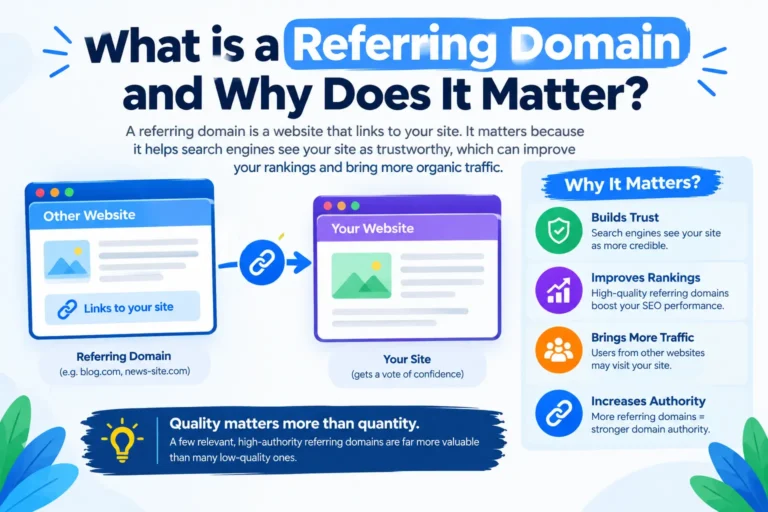
Referring domain count — Each published guest post should add one new referring domain. Track this growth monthly.
Referral traffic — Check Google Search Console for traffic arriving from your guest post URLs. High referral traffic signals the site has a real, engaged audience — not just a DA number.
Ranking improvements — Monitor target keyword positions for pages receiving the guest post backlinks. Improvement over 6 to 12 weeks confirms the links are passing meaningful PageRank.
Frequently Asked Questions (FAQ)
Is guest posting still effective in 2026?
Yes. Guest posting on legitimate, relevant sites with real audiences remains one of the most effective link-building methods available. Google’s John Mueller has confirmed that quality guest posts are an accepted practice. What Google targets is mass, low-quality guest posting done purely for links — not genuine editorial contributions to real publications.
How do I find sites that accept guest posts?
Search Google using operators like your niche + "write for us", your niche + "guest post guidelines", or your niche + "submit a post". Also check competitor backlink profiles for links that appear to be guest posts, and search social media for writers in your niche who share their published guest articles.
What DA should a guest post site have?
Target sites with DA 30 and above for meaningful link value. Below DA 20, the backlink contributes minimally to your own Domain Authority. Also check Spam Score — avoid sites above 40% Spam Score even if their DA appears high, as links from spammy sites can raise your own Spam Score.
How many links can I include in a guest post?
Keep self-links to 1 to 2 per article maximum. One well-placed, contextually natural link passes more value than three forced ones. Most legitimate editors will remove excess self-promotional links before publishing. Place your link where it genuinely adds reference value for the reader.
What anchor text should I use in guest posts?
Use varied, natural anchor text across your guest posts. Avoid using the same exact-match keyword phrase every time — this creates an unnatural anchor text distribution that Google’s Penguin algorithm targets. Mix branded anchors (your site name), descriptive phrases, partial-match keywords, and naked URLs.
How long should a guest post be?
Match the host site’s typical article length. Most quality blogs accept articles between 1,200 and 2,500 words. Longer articles (2,000 to 3,000 words) tend to perform better in search and show more editorial effort — which editors appreciate. Check what length their existing articles run and aim for the same range.
How do I write a guest post pitch that gets accepted?
Personalize your pitch by referencing a specific article you read on their site. Offer 2 to 3 specific article ideas with working titles rather than a vague offer to write about anything. Include brief credentials and 1 to 2 writing samples. End with a simple yes/no question. Keep the entire email under 200 words.
How long does it take for a guest post backlink to affect Domain Authority?
Moz updates DA monthly, so new guest post backlinks typically begin affecting your DA score within 4 to 8 weeks of Moz’s crawler discovering and indexing the link. Google ranking improvements from the earned backlinks generally appear within 6 to 12 weeks for moderate-competition keywords.
Can guest posting hurt my website?
Yes — if done incorrectly. Guest posting on link farms, publishing thin or duplicate content, using excessive exact-match anchor text, or placing too many self-promotional links can attract Google penalties. Stick to legitimate sites with real audiences, write genuinely useful articles, and use natural anchor text. Quality over volume is the rule that keeps guest posting safe and effective.