What is E-E-A-T and How Does It Affect Domain Authority?
E-E-A-T is not a ranking factor you can measure with a tool — but it shapes how Google evaluates every page on your site, and it directly influences the backlinks and authority signals that do move your DA.
This guide explains what E-E-A-T is, where it comes from, how Google uses it, and what you can do to improve it.
What Is E-E-A-T?
E-E-A-T stands for Experience, Expertise, Authoritativeness, and Trustworthiness. It is a framework Google uses to evaluate the quality of web content — drawn from Google’s Search Quality Rater Guidelines, a document that trains human raters who assess search result quality.
The four components:
Experience — Does the author have first-hand, real-world experience with the topic? A review of a product written by someone who has actually used it demonstrates experience. A summary of other reviews does not.
Expertise — Does the author have the knowledge and skill required to write authoritatively on this topic? A medical article written by a licensed physician demonstrates expertise. The same article written by a general content writer does not — regardless of research quality.
Authoritativeness — Is the author and the website recognized as an authority in their field? Authoritativeness is external — it is built through citations, backlinks, mentions in credible publications, and being referenced by experts in the same field.
Trustworthiness — Is the content accurate, transparent, and safe? Does the site have clear authorship, privacy policies, contact information, and editorial standards? Trust is the foundation — Google considers it the most important component of E-E-A-T.
A brief history: E-A-T (without the first E) was introduced in Google’s Quality Rater Guidelines in 2014. The first “E” for Experience was added in December 2022, acknowledging that first-hand experience carries distinct value — particularly for product reviews, travel content, and practical how-to guides.
Is E-E-A-T a Direct Ranking Factor?
No — and this is a common misunderstanding worth clarifying.
E-E-A-T itself is not a direct algorithmic ranking signal that Google measures with a specific score. Google has confirmed this. There is no “E-E-A-T score” that you can check in any tool.
What E-E-A-T is: a quality framework that Google’s algorithms attempt to evaluate through hundreds of indirect signals. Google’s automated systems try to identify content that demonstrates experience, expertise, authoritativeness, and trustworthiness — using signals like:
- Who links to your content (authoritativeness)
- How your content is cited across the web
- The credentials and track record of the author
- The accuracy and depth of information on your pages
- The technical trustworthiness of your site (HTTPS, privacy policy, contact info)
- User engagement signals — do people stay on your page or bounce back?
The practical implication: improving E-E-A-T means improving the underlying signals Google uses to evaluate it — which are many of the same signals that influence Domain Authority.
How E-E-A-T Relates to Domain Authority
Domain Authority and E-E-A-T are not the same thing — but they are deeply connected. Here is how:
Authoritativeness → Backlinks → Domain Authority
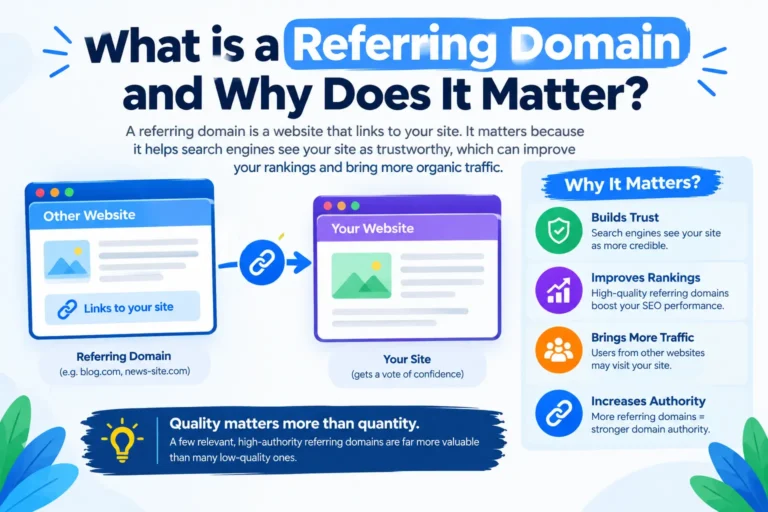
The “Authoritativeness” component of E-E-A-T is largely measured by who links to you. When authoritative sites in your field link to your content, they are signaling to Google that your site is a credible source. These are the same backlinks that build Domain Authority.
A site with strong E-E-A-T signals — recognized experts, frequent citations from reputable sources, references in industry publications — naturally accumulates high-quality backlinks. And high-quality backlinks are the primary driver of Domain Authority.
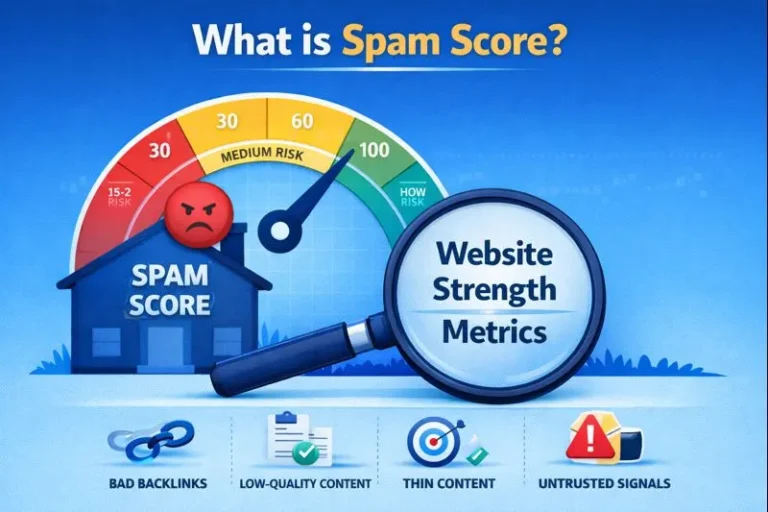
Trustworthiness → Clean Link Profile → Lower Spam Score
Trust signals that contribute to E-E-A-T — transparent authorship, accurate information, no deceptive practices — correlate with the kind of site that earns legitimate editorial backlinks rather than manipulated ones. Sites with strong trust signals tend to have lower Spam Scores and cleaner backlink profiles.
Expertise → Better Content → More Earned Links
Content that demonstrates genuine expertise earns more natural backlinks than generic content does. When a recognized expert writes a comprehensive guide, other sites in that field are more likely to reference and link to it. This organic link earning is the most sustainable way to build Domain Authority over time.
The summary: You cannot improve Domain Authority directly through E-E-A-T — but building genuine E-E-A-T naturally produces the backlinks, trust signals, and editorial recognition that improve DA as a consequence.
Which Niches Does E-E-A-T Matter Most?
Google applies E-E-A-T evaluation most rigorously to what it calls YMYL (Your Money or Your Life) content — topics where low-quality or inaccurate information could cause real harm to users.
YMYL categories include:
- Health and medical advice
- Financial advice and investment information
- Legal information
- Safety and emergency guidance
- News and current events
- Government and civic information
For YMYL content, Google’s quality raters apply E-E-A-T standards very strictly. A health article written by an anonymous author with no medical credentials on a site with no clear editorial policy will struggle to rank — regardless of how well-optimized it is technically.
For non-YMYL niches — SEO tools, software, lifestyle, entertainment — E-E-A-T standards are applied less strictly. However, the authoritativeness component (backlinks and editorial recognition) matters across all niches as it directly feeds into Domain Authority.
For a site like a domain authority checker or SEO metrics tool, the most relevant E-E-A-T components are authoritativeness (backlinks from SEO publications) and trustworthiness (clear tool methodology, accurate data, transparent about how metrics are calculated).
The Four Components — How to Build Each One
Building Experience
Experience signals come from demonstrating that content is written by someone with direct, practical knowledge of the topic — not just research.
How to demonstrate experience:
- Include first-person examples and case studies from your own work
- Reference specific results you have achieved (e.g., “When we increased internal links to this page, PA rose from 18 to 27 within 6 weeks”)
- Show screenshots, data, or real-world examples from your own experience
- Write about topics you have actually implemented, not just researched
For an SEO tool site, this means publishing data from real analyses, actual case studies of sites that improved their DA, and practical guides based on real-world tool usage — not just theoretical explanations.
Building Expertise
Expertise signals come from demonstrated knowledge depth and author credentials.
How to demonstrate expertise:
- Create comprehensive, in-depth content that covers topics thoroughly
- Attribute content to named authors with verifiable credentials
- Include author bio pages with professional background, publications, and social profiles
- Be cited by other experts in your niche as a reference
- Publish original research, data, and analysis that only an expert could produce
The depth of your content matters. A 2,500-word guide that covers every angle of a topic demonstrates more expertise than a 600-word overview — even if both are technically accurate.
Building Authoritativeness
Authoritativeness is the most directly connected to Domain Authority — it is largely measured by external recognition through backlinks and citations.
How to build authoritativeness:
- Earn backlinks from established sites in your niche — especially those with high DA themselves
- Get cited and referenced by other experts in your field
- Contribute guest articles to recognized industry publications
- Be quoted as a source in press coverage and industry reports
- Build a presence on platforms where your field’s experts gather (LinkedIn, industry conferences, podcasts)
- Have your tools and resources recommended by recognized authorities
For an SEO tool site, authoritativeness means being recommended by SEO professionals, cited in SEO blog posts, and referenced in guides about domain authority or backlink analysis.
Building Trustworthiness
Trust is the foundation of E-E-A-T. Google considers it the most important component. Without trust, strong performance in the other three areas has limited impact.
How to build trustworthiness:
- Use HTTPS (secure connection) — non-HTTPS sites are automatically lower trust
- Publish a clear About page explaining who operates the site and their background
- Include Contact page with real contact information
- Display Privacy Policy and Terms of Service
- Show transparent methodology — for a tool site, explain how metrics are calculated
- Keep information accurate and up to date — outdated or incorrect information destroys trust
- Avoid deceptive design patterns, misleading claims, or manipulative CTAs
- Maintain consistent, accurate information across all your content
For a site that displays authority metrics like DA, PA, and Spam Score, the trust component includes being transparent about what your data means, where it comes from, and its limitations.
E-E-A-T Signals Google Can Actually Measure
Since E-E-A-T is not a single algorithmic score, understanding which signals Google’s systems actually use helps you prioritize:
Signals Google can measure algorithmically:
| Signal | How Google Reads It |
|---|---|
| Backlink profile quality | Authoritative sites linking to you = authoritativeness signal |
| Named author attribution | Content attributed to a real, verifiable person vs anonymous |
| Author’s existing web presence | Does this author have published work, social profiles, credentials? |
| Site’s overall backlink profile | Domain-level trust through referring domain quality |
| User engagement metrics | Click-through rate, dwell time, return visits — trust proxies |
| Content accuracy over time | Pages that are updated to stay accurate vs left outdated |
| Schema markup | Author schema, Article schema, Organization schema provide entity clarity |
| Brand mentions across the web | Being cited without a link still signals entity recognition |
| HTTPS and technical security | Basic trust infrastructure |
| Business information consistency | NAP consistency (Name, Address, Phone) for local sites |
Signals human raters evaluate (that influence algorithm training):
- Clarity of who wrote the content and their credentials
- Evidence of first-hand experience in the content
- Depth and accuracy of information
- Editorial standards and fact-checking
- Transparency about the site’s purpose and ownership
Practical Steps to Improve E-E-A-T on Your Site
Step 1 — Add author bios to all content: Every article should have a named author with a brief bio explaining their relevant expertise. Link the author name to a full author page with credentials, social profiles, and other published work.
Step 2 — Create a strong About page: Your About page should clearly explain who operates your site, their background, what makes them qualified to cover these topics, and why readers should trust your information.
Step 3 — Add schema markup: Implement Article schema, Author schema, and Organization schema on your site. Schema helps Google understand the entities behind your content — a key component of entity-based E-E-A-T evaluation.
Step 4 — Update old content regularly: Outdated content damages trust. Review your existing articles at least twice a year. Add “Last Updated” timestamps to articles that have been reviewed. Remove or correct outdated information.
Step 5 — Earn mentions and citations from credible sources: Guest posting, HARO responses, Digital PR campaigns, and expert roundups all produce the kind of external recognition that builds authoritativeness signals — and as a direct consequence, Domain Authority.
Step 6 — Publish original research and data: Original data that other sites want to cite is one of the most powerful E-E-A-T signals available. It demonstrates expertise, generates authoritative backlinks, and positions your site as a primary source rather than a secondary reference.
Step 7 — Display trust signals prominently: Privacy Policy, Contact information, About page, and HTTPS are minimum requirements. For a tool site, also explain how your data is sourced and calculated — transparency about methodology is a strong trust signal.
E-E-A-T and AI Content in 2026
One of the most common questions in 2026 is how E-E-A-T applies to AI-generated content.
Google’s official position: it does not care whether content is written by a human or AI — it cares whether the content demonstrates E-E-A-T. AI-generated content that is accurate, well-researched, attributed to a credible author, and backed by genuine expertise can rank well. AI content that is generic, unverified, and anonymous cannot.
The practical implication: AI-generated content needs the same E-E-A-T signals as human-written content — named authorship, factual accuracy, expert review, and external citation signals. Without these, AI content tends to be exactly what Google’s systems are trained to identify as low-quality: high-volume, generic, interchangeable content with no unique insight.
Frequently Asked Questions (FAQ)
What does E-E-A-T stand for in SEO?
E-E-A-T stands for Experience, Expertise, Authoritativeness, and Trustworthiness. It is Google’s quality framework for evaluating web content, drawn from its Search Quality Rater Guidelines. The first E for Experience was added in December 2022. Google uses hundreds of indirect signals to algorithmically assess E-E-A-T — it is not a direct ranking score but a quality standard that influences how Google’s systems evaluate content.
Is E-E-A-T a direct Google ranking factor?
No. Google has confirmed that there is no single E-E-A-T score that directly determines rankings. E-E-A-T is a quality framework that Google’s algorithms try to evaluate through indirect signals — primarily backlinks, author credentials, brand mentions, content depth, and trust infrastructure. Improving E-E-A-T means improving the underlying signals Google uses to assess it.
How does E-E-A-T affect Domain Authority?
E-E-A-T and Domain Authority are connected through backlinks. The Authoritativeness component of E-E-A-T is largely measured by who links to your content — the same editorial backlinks that build Domain Authority. A site with strong E-E-A-T naturally earns high-quality backlinks from credible sources, which drives DA growth. You cannot improve DA directly through E-E-A-T, but building genuine authority produces the backlinks that do.
What is YMYL content and why does E-E-A-T matter more for it?
YMYL stands for Your Money or Your Life — content categories where inaccurate information could harm readers (health, finance, legal, safety). Google applies E-E-A-T standards most strictly to YMYL content because the stakes of low-quality information are highest. Medical advice from uncredentialed authors or financial guidance from anonymous sites faces heavy algorithmic scrutiny regardless of other SEO signals.
How do I demonstrate Experience for E-E-A-T?
Demonstrate experience by including first-person examples, real case studies, and specific results from your own work. For an SEO tool site, this means publishing real data analyses, actual before-and-after metrics from site improvements, and practical guides based on genuine tool usage. Content that only summarizes what others have said demonstrates no direct experience.
How can I improve my site’s E-E-A-T?
Add named author bios with verifiable credentials to all content, create a detailed About page explaining site ownership and expertise, implement Article and Author schema markup, earn backlinks from recognized sites in your niche through guest posting and Digital PR, publish original research that gets cited by others, keep content accurate and updated, and ensure your site has HTTPS, a privacy policy, and clear contact information.
Does E-E-A-T apply to AI-generated content?
Yes. Google evaluates whether content demonstrates E-E-A-T regardless of whether it was written by a human or AI. AI content needs the same signals: named authorship, factual accuracy, expert review, and external citation signals. Generic, anonymous AI content without genuine expertise signals tends to perform poorly under E-E-A-T evaluation — not because it is AI-generated, but because it lacks the underlying quality signals Google is looking for.
What is the difference between E-E-A-T and Domain Authority?
E-E-A-T is Google’s quality evaluation framework for content — it assesses experience, expertise, authoritativeness, and trust. Domain Authority is Moz’s third-party metric predicting a site’s overall ranking likelihood based primarily on its backlink profile. They are related — strong E-E-A-T produces the editorial backlinks that build DA — but they measure different things. DA is a number you can check with a tool. E-E-A-T is a quality standard without a single visible score.
Which E-E-A-T component matters most for SEO?
Google considers Trustworthiness the most important component — it is the foundation everything else rests on. Without basic trust signals (HTTPS, accurate information, transparent authorship), strong expertise or authoritativeness cannot fully compensate. For building Domain Authority specifically, Authoritativeness is most directly actionable because it is measured through backlinks — the primary DA driver — which you can actively build through link-building campaigns.